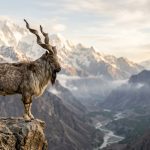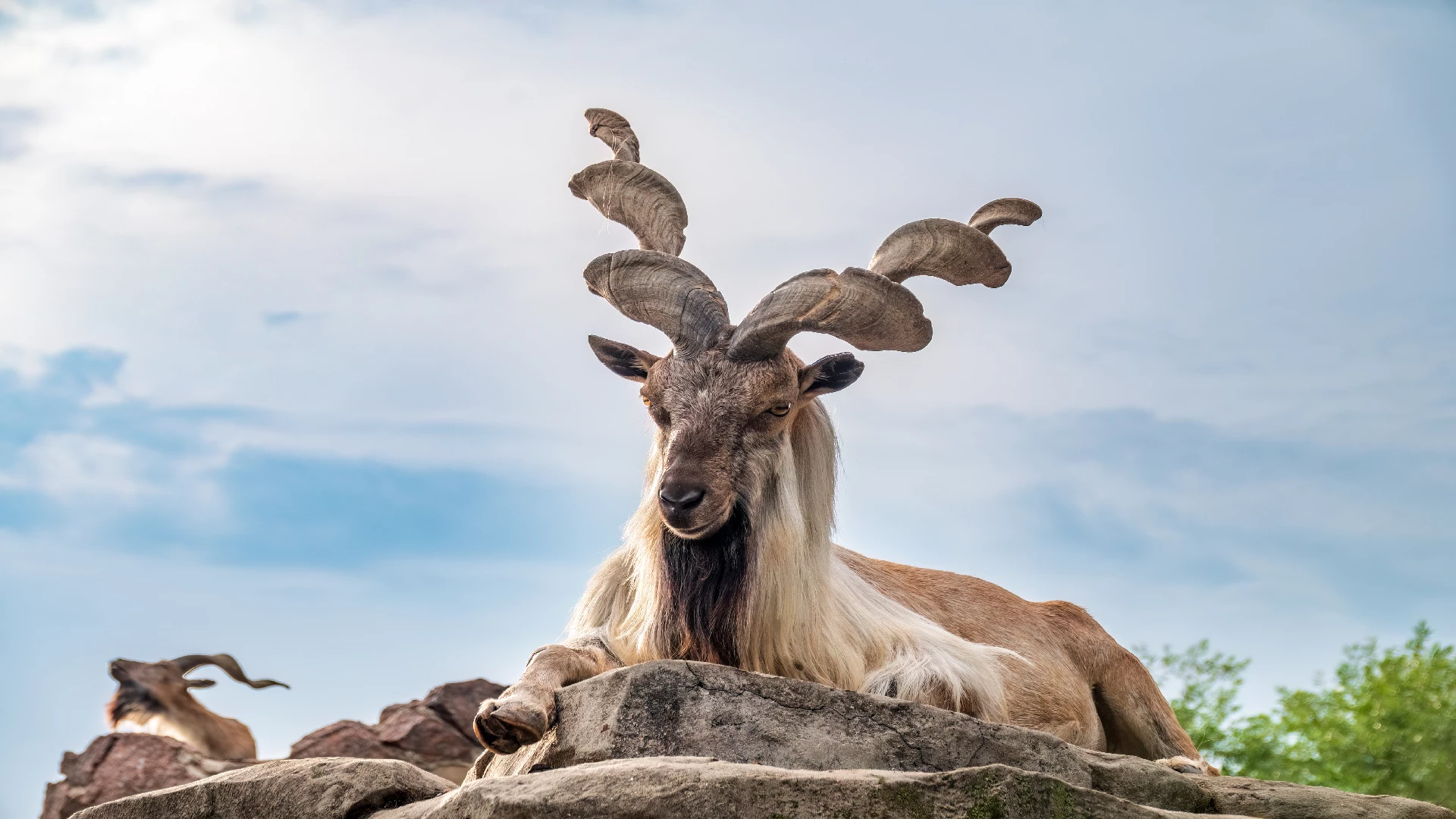
The Markhor (Capra falconeri)—just saying the name feels like an adventure, doesn’t it? This isn’t just a goat; it’s the king of wild goats, the largest one on earth. And oh, those horns! They’re absolutely spectacular, twisting their way up to the sky. These animals literally defy gravity, scaling cliffs that you and I would need ropes to even look at.
The markhor is also Pakistan’s national animal, and today its populations are sustained through tightly regulated trophy hunting programmes.
If you’re gearing up for a mountain trip through Central Asia, or you’re just one of those people (like me) who get completely pulled in by nature’s most remarkable creatures, this is everything you need to know.
Let’s start by understanding what makes the Markhor unique.
Think of the Markhor as nature’s ultimate high-altitude athlete. It’s a wild mountain goat species famous for three things: those incredible spiral horns, its almost supernatural ability to climb, and a set of survival skills perfectly adapted for the highest, harshest places.
There are several local variations of Markhor, similar to how athletes differ by region. Three main subspecies can be found, each adapted to a distinct mountainous area:
- The Astor Markhor: You’ll find these mainly in the Gilgit-Baltistan region of Pakistan—specifically, the Astore and Diamer districts.
- The Kashmir Markhor: They roam the rugged, green slopes of Khyber Pakhtunkhwa, especially the Chitral Gol National Park.
- The Suleiman Markhor: These are native to the more arid Torghar Hills of Balochistan and tend to have tighter horn spirals than their northern cousins.
That brings us to their recent conservation journey: once listed as ‘Endangered’—a true worry for conservationists and wildlife fans alike—by 2015 they were upgraded to Near Threatened. This positive change reflects the impact of successful, community-based conservation programs in Pakistan and Tajikistan, showing how human effort can directly benefit these mountain dwellers.
🐐 Markhor Physical Traits: Why They’re Built for Vertical Living
To really appreciate the Markhor, you have to look past the magnificent horns and see the highly specialized design underneath. This isn’t evolution, it’s engineering!
Size, Stature, and the Mountain Man’s Mane
The males are robust. Seriously muscular. They’re the heavyweights, often weighing between 80 and 110 kilograms (that’s 176 to 242 pounds) and standing over a meter tall at the shoulder. They also sport this impressive, flowing “ruff” or mane that runs from their chin to their chest. That isn’t just for looks—it’s a powerful sign in the mountain dating game, playing a huge role in sexual selection and who gets to be the boss.
The females? They’re considerably smaller and lighter, often just 32 to 50 kilograms. This smaller stature is their advantage, making them perfectly adapted for lightning-fast agility over brute-force combat.
The Horns: Nature’s Spiral Towers
This is the Markhor’s calling card, right? Their horns are a continuous spiral that just keeps growing throughout the animal’s life. Think of it like a tree’s rings, but far more dramatic.
The males reach incredible sizes. We have documented cases in Gilgit-Baltistan where Astor Markhor horns have exceeded a stunning 160 centimeters (63 inches). The Suleiman variety usually hits a slightly smaller 90 to 100 centimeters, but with that super tight, captivating twist. The females’ horns are much shorter (15 to 25 cm) and functional—they’re for defense, not for showing off.
Wait, Let Me Explain This Better: The Secret of the Hoof
This is the part that makes you go, “Oh, I get it now.” How do they climb sheer rock? It’s all in the hoof.
If you look at their hooves , you see a mechanism that climbers call “counter-pressure,” which means pushing both front and back hooves against different surfaces to stay balanced on rocks.
- The Outer Rim: This is a hard, sharp, keratinous edge, perfect for cutting into ice or grabbing a tiny soil purchase.
- The Inner Pad: This is soft and spongy, providing the kind of incredible, non-slip friction you need on smooth rock.
This dual design allows them to push their front and back hooves against opposing rock surfaces, essentially stemming up narrow rock chimneys, just like a human rock climber. It lets them literally scale near-vertical cliffs—an essential move to escape predators and reach that one patch of grass no one else can touch.
🏔️ Habitat & Home: Markhor’s Place in the Mountain World
To truly understand the Markhor, you need to see their home—it’s a demanding, high-stakes environment.
The Vertical Niche
They occupy this fascinating vertical zone, anywhere between 600 meters and 3,600 meters in elevation. They aren’t interested in the flat, easy land. They want the precipitous cliffs mixed in with scrublands and dry temperate forests (like where the Holly Oak lives). Why? They want to be where they can always retreat vertically. They actively avoid deep, heavy snow because it cripples their mobility.
The Lay of the Land (Pakistan Strongholds)
The conservation work is paying off, and recent surveys give us some great numbers. It’s genuinely heartening to see these populations stable or growing:
- Gilgit-Baltistan: The 2024 study estimates around 2,024 individuals here.
- Chitral Gol National Park: A major win! Recent counts show a stable population of over 2,200 Markhors.
- Balochistan (Suleiman): This subspecies is estimated at roughly 3,922 individuals, though they’re spread out over a much wider, more arid area.
The Yearly Dance: Seasonal Migration
Like many mountain dwellers, the Markhors are altitudinal migrants. They do a yearly “up and down” dance:
- Summer: They hike up to the high alpine meadows (above 3,000 meters) to gorge on the fresh, lush forage.
- Winter: When the snow starts piling up, they descend 800 to 1,200 meters into lower valleys. They look for south-facing slopes, because that’s where the sun melts the snow fastest, keeping the crucial food accessible.
🍴 Diet and the Dreaded Competition
What keeps these powerhouse climbers fueled? Well, it changes with the seasons, and sometimes, it brings them into direct conflict with other mountain residents.
What’s on the Menu?
The Markhor is an “intermediate feeder”—that means it can both graze on grasses and browse on shrubs and trees, depending on what’s available. Their primary diet includes things like Holly Oak, Juniper, and Olive trees, along with various grasses and herbs.
The Struggle: Sharing a Plate
Here’s a harsh reality from a 2014 study: in the summer, there’s a nearly 99% diet overlap between Markhors and domestic goats (the ones herded by people). This intense competition for the best highland pastures often forces the wild Markhors into those suboptimal, steeper terrains just to avoid the livestock. It’s a huge ecological challenge that impacts their growth and overall health.
The Dinner Bell (or Lack Thereof)
They tend to be crepuscular. That means they’re most active at dawn and dusk. They feed most actively in the early morning (around 5:00 to 8:00 AM) and late afternoon (4:00 to 7:00 PM). This strategy is smart: it minimizes exposure to the intense midday heat and, critically, to predators.
🤝 Social Life & Survival Tactics
These aren’t solitary mountain hermits; they have a complex social structure designed purely for survival.
Who’s in the Herd?
- Females and Kids: They form stable, matriarchal herds of 8 to 12 individuals. An older, experienced female is usually the one leading the decisions.
- Adult Males: Outside of mating season, they are largely solitary or form loose “bachelor herds.” This separation is actually brilliant, as it minimizes competition for food with the mothers and young.
When the Boys Fight
Markhors aren’t territorial in the traditional sense, but the males sure do care about who’s top dog. They establish strict dominance hierarchies using physical displays and, notably, scent marking with glands near their eyes. It’s a chemical announcement during the mating season to signal, “I am fit, and I am here.”
The Ultimate Defense: Terrain Buffering
When a Markhor herd spots a threat (and one female is usually designated as the sentinel), they don’t hide—they explode uphill towards the cliffs. Their primary defense is their home turf. They use their incredible ability to jump vertically up to 2 meters to reach safety ledges that are simply inaccessible to their main predators, like wolves and snow leopards. That amazing jumping ability is their life insurance policy.
🧬 Reproduction & The Circle of Life
Understanding how they reproduce shows us the rhythm of their challenging year.
The Rut (October–December)
This is a high-energy time, a proper spectacle. The dominant males aggressively defend access to the female herds. They engage in brutal horn-locking battles that look like a slow-motion wrestling match—twisting and shoving to unbalance the opponent. These intense bouts can last 15 to 25 minutes, and the winner gets the mating rights.
New Life in the Spring
Gestation is 135 to 170 days. The kids are born in late spring (May–June). This timing isn’t accidental—it perfectly coincides with the peak of plant growth, meaning the mothers have the best possible nutrition for milk production. While a single birth is standard, twins are actually common when the habitat is healthy and food is plentiful!
The Hard Truth: Mortality
In the wild, Markhors can live for 10 to 13 years. But here’s where the mountains are tough: juvenile mortality can be as high as 30% to 50% in that first winter, thanks to predation (especially by Golden Eagles) and the sheer exposure to the cold. It’s a high-risk start, which is standard for mountain ungulates.
Naturally, sharing the mountains means the Markhor must always be wary of predators.
Markhors have to constantly watch their backs, mainly from a few apex hunters.
They are the primary prey for two icons of the high mountains: the endangered Snow Leopard (Panthera uncia) and the Himalayan Wolf. Interestingly, studies show that in some regions, Markhor only makes up about 2% of the wolf’s diet, which tells you just how effective that “flee-to-the-cliffs” strategy is! Golden Eagles are the silent, aerial threat, particularly to the vulnerable young kids.
🌿 Markhor’s Place in the Web of Life
These animals are more than just targets for predators or cool sights for tourists; they are active architects of their environment.
The Ecosystem Gardeners
As they browse on tough, woody vegetation, Markhors are essentially preventing shrub encroachment in the alpine meadows. They keep habitats open, supporting a massive diversity of other plant species. Their grazing is an essential service for mountain ecosystem health and biodiversity.
The Apex Link
A stable Markhor population is directly linked to the survival of their predators. When the Markhor thrives, the endangered snow leopards and Himalayan wolves have a better chance of thriving, too. They are the crucial, necessary connection in the high-altitude food web.
🤔 Your Questions, Answered
Can Markhor climb vertical cliffs?
Absolutely, yes. It’s not just a rumor. Their unique hoof (hard rim, soft pad) and low center of gravity allow them to use that counter-pressure technique to scale near-vertical rock faces. It’s perhaps their most incredible party trick.
Do Markhor migrate in winter?
Yes, they’re altitudinal migrants. They perform a massive, necessary descent of 1,000 meters or more from the snowy peaks to the lower valleys to find food they can actually access.
Are Markhor aggressive?
They are very shy and elusive towards people. You won’t see them looking for a fight with a hiker. However, during the winter rutting season, the males are incredibly aggressive toward each other, engaging in those intense horn battles for breeding rights.
Can Markhor live with Ibex?
Yes, but they smartly separate by altitude. The Ibex generally prefers the higher, snowier peaks (above 3,500 meters), while the Markhors prefer the lower, scrubbier precipices below the heavy snowline. This natural separation helps reduce competition for resources.
Are Markhor endangered?
They are currently listed as Near Threatened by the IUCN (since 2015). They’ve bounced back significantly from critical lows in the 1990s, proving that dedicated, local conservation efforts in Pakistan and Tajikistan truly work.
Ready for Your Markhor Adventure?
Understanding the Markhor’s biology and behavior—from the spectacular spiral horns to their impossible climbing technique—just adds so much depth to any mountain trek. They are a genius solution to the problem of surviving in the world’s highest, harshest environments.
The fact that they’ve recovered from being Endangered is a beacon of hope. By choosing responsible, ethical tourism and supporting local conservation programs, your adventure in Markhor country becomes more than just a trip—it becomes a vital part of protecting these extraordinary creatures for every generation to come.
Embark on this once-in-a-lifetime adventure with Pak Adventure and experience the wild beauty of Markhor country while supporting conservation efforts. Book your expedition today!

Tahir is a renowned outdoor adventure specialist and wildlife tourism consultant with over 15 years of experience exploring Pakistan’s diverse hunting and fishing destinations. Based in Islamabad, he has guided expeditions across the Northern Areas, from the trout-rich streams of Gilgit-Baltistan to the high-altitude ibex hunting grounds of the Karakoram range.